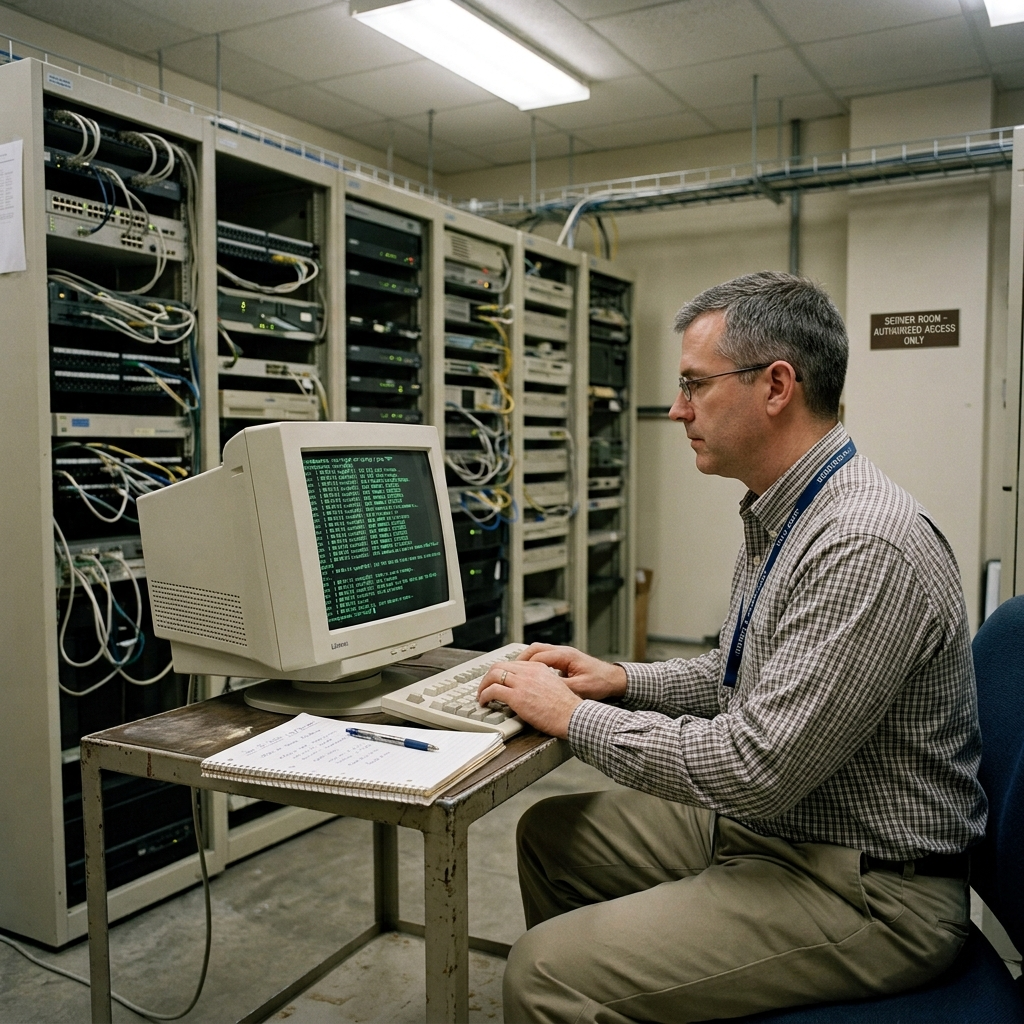
## The Y2K Bug That Kept Its Appointment — 26 Years Late
Earlier this month, an IT professional at a small regional hospital chain was troubleshooting an unrelated issue in the organization’s Laboratory Information System. To avoid confusion with live orders, they attempted to enter a test order dated ten years into the future. It failed. They tried 2030 — failed. 2027 — worked. Through methodical testing, they narrowed the failure boundary to precisely January 1, 2028.
What they uncovered was not a new defect. It was a Y2K fix that had been quietly counting down its own expiration date for nearly three decades.
The LIS in question was custom-built in the late 1980s by a small external vendor. Like many systems of that era, it stored years as two digits to conserve disk and memory — resources that were genuinely scarce at the time. As the year 2000 approached, the vendor faced a choice: rewrite the system for four-digit year handling, or implement a workaround.
They chose the workaround.
The Gregorian calendar repeats exactly every 28 years. The vendor’s team realized they could set the system clock back by 28 years, letting the LIS continue operating with two-digit years internally. Year conversion — incrementing or decrementing by 28 — was patched only at the interface layer, where the LIS communicated with other hospital systems via HL7. From the LIS’s perspective, the years 2000 through 2027 mapped to 1972 through 1999. Everything worked.
The fix held for 28 years without a recompile. The vendor itself shrank over time, eventually becoming a solo consultancy run by the original developer — now an elderly woman who still supports the systems she wrote decades ago.
### Why This Matters Beyond the Anecdote
This story resonates in enterprise environments because it reflects a pattern most operations leaders have encountered: the temporary fix that becomes permanent. The workaround that outlasts the team that built it. The system that runs reliably for so long that nobody remembers why it was configured a certain way — until the configuration quietly expires.
In healthcare, manufacturing, logistics, and financial services, systems built in the 1980s and 1990s remain operational. Many have been ported across operating systems, wrapped in modern APIs, and integrated with contemporary platforms — but their internal logic remains untouched. The risk is rarely catastrophic failure. More often, it’s the slow accumulation of brittle assumptions that surface during routine operations.
### The Fix, Then and Now
When the hospital called the original developer, she confirmed the issue within hours. Her resolution was characteristically pragmatic: change the offset from 28 years to 56 years, set the system date to 1970, and recompile the software for the first time since the late 1990s.
Notably, the system does not rely on Unix timestamps or 32-bit epoch values — the date manipulation is simple integer math on the year field. The Epochalypse (the 2038 problem) will not affect this machine. It will, in all likelihood, outlast the retirement of everyone who currently knows it exists.
### The Operational Lesson
When evaluating system risk, organizations tend to focus on obvious threats: cybersecurity vulnerabilities, end-of-life software, unsupported infrastructure. This story highlights a subtler category: logic-level time bombs embedded in workarounds that were documented decades ago — if they were documented at all.
For operations leaders and founders managing legacy enterprise systems, the question is not whether these workarounds exist. It’s whether anyone still remembers where they are, what boundary conditions trigger them, and who to call when they finally activate.
In this case, the right person was still reachable. That is not always true — and when it isn’t, a 28-year-old calendar offset can become a far more expensive problem than the original Y2K fix ever was.