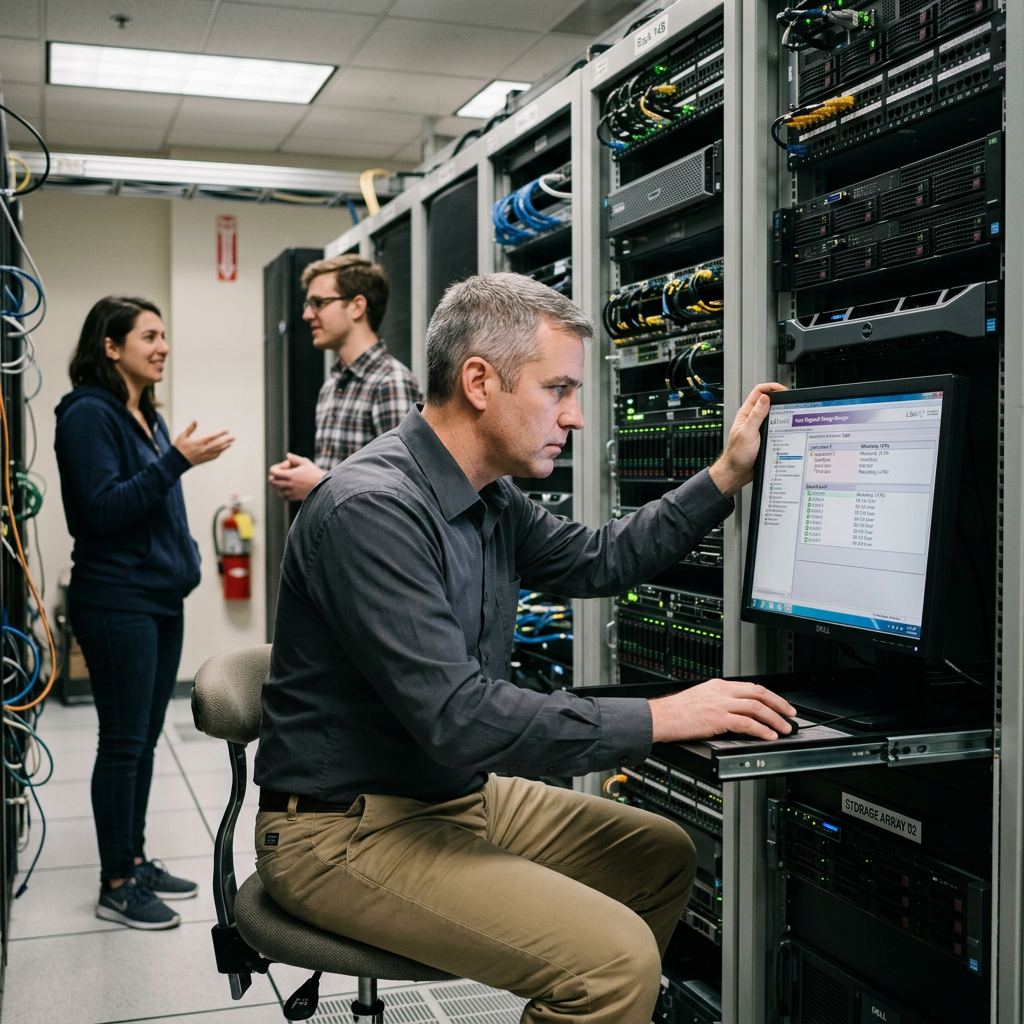
Years ago, during an on-site engagement, an IT consultant arrived a few days before the holidays to add storage to a server. Two junior staff members were asking questions while he worked inside the RAID configuration utility. In that distracted window, he deleted the existing array instead of creating a new one.
That array held Exchange, the domain controller, file services, and SQL. Terabytes of production data across the entire environment.
He told the client immediately. Then he spent the holiday break restoring from backups that proved slow and unreliable. The Exchange server required multiple restores before it came back cleanly. Recovery took a full week, with another two weeks spent resolving lingering issues.
The root cause wasn’t the interface. It was a high-risk change performed in an uncontrolled environment.
In many organizations, this pattern is more common than leadership realizes. Critical changes—storage reconfiguration, permission updates, integration deployments, data migrations—are performed during normal working hours, surrounded by the routine interruptions of the business. People ask questions. Alerts come in. Meetings run over. The person doing the work is expected to manage all of it at once.
This is where process discipline becomes operationally critical.
A controlled change window would have meant an agreed time, a defined scope, and an explicit expectation that the engineer not be interrupted. A written change record would have forced a pause to verify the existing configuration before any modification. A peer review would have added a second set of eyes before the array was touched. Any one of those controls likely prevents the failure entirely.
The second lesson is about backup reliability. The organization had backups. That fact did not make recovery fast or straightforward. Backups that have never been tested under realistic restore conditions are not a recovery plan—they’re an assumption. In this case, the assumption held, but only just, and only after a week of manual effort.
The third lesson is about accountability. The consultant did not blame the junior staff, the interface, or the timing. He owned the mistake, communicated it directly, and did the recovery work without charge. That kind of accountability is rare, and it matters. It preserves trust and keeps the focus where it belongs: on fixing the process, not assigning blame.
For operations leaders, the takeaway is simple. High-risk work should not be scheduled like routine work. It deserves a controlled window, a written plan, a peer check, and a recovery path that has been tested before it is needed. Process discipline is not bureaucracy. It is the difference between a routine maintenance visit and a week of emergency recovery.