In enterprise transformation work, ERP projects typically command the attention of the steering committee. Vendor selection, module configuration, data migration, and user training dominate the agenda. But beneath the surface of every ERP implementation sits an operational layer that receives far less scrutiny — and it’s often where the project’s long-term viability is quietly determined.
A Pattern That Repeats Across Organizations
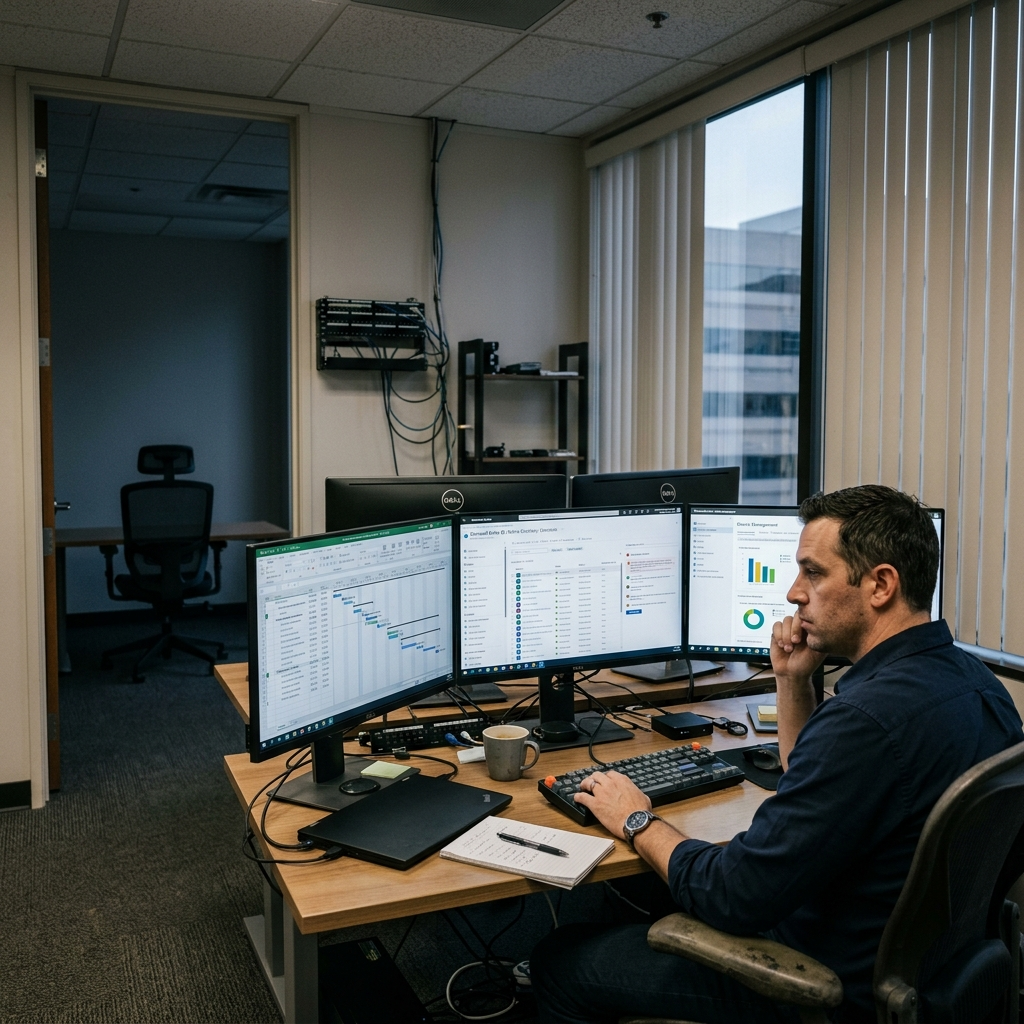
Consider a scenario observed across many small-to-midsize organizations. An IT manager departs — whether through restructuring, attrition, or reorganization. The remaining team member inherits not only day-to-day support responsibilities but also identity infrastructure management, device provisioning, vendor oversight, and a seat at the ERP migration table.
The workload expands. The title does not. The compensation remains calibrated to the original role.
Meanwhile, the operational environment reveals deeper gaps. Devices are domain-joined and configured manually — no Intune, no automated provisioning, no policy-driven deployment. Cloud infrastructure is absent. Documentation, if it exists at all, lives in the departed manager’s memory. The organization is now running an ERP migration with one person holding the operational knowledge required to keep the underlying systems functional.
This is not a staffing problem. It is an architectural one.
Where the Risk Actually Concentrates
The risk is not simply that the remaining person might leave — though that is certainly part of the equation. The deeper issue is that the organization’s systems architecture was never designed to distribute operational knowledge, automate routine provisioning, or survive personnel changes.
When laptops are configured by hand, every new hire or device refresh depends on institutional memory residing in one individual. When identity management sits entirely with a single administrator, access governance becomes a single-threaded function with no failover. When cloud modernization has not been prioritized, the organization remains tethered to on-prem fragility that compounds with every passing quarter.
An ERP migration layered on top of this foundation inherits every one of these vulnerabilities — regardless of how competent the remaining person is.
What Makes This Operationally Recoverable
Organizations facing this situation — or looking to avoid it — typically benefit from three structural adjustments before or during the ERP migration window.
First, device management modernization. Moving to Intune or an equivalent MDM platform transforms device provisioning from a manual dependency into a policy-driven, repeatable process. This alone removes a significant operational bottleneck and creates resilience that extends beyond any individual role.
Second, documentation architecture. Not simply process notes, but structured documentation of system configurations, vendor relationships, provisioning workflows, and escalation paths. The objective is to make operational knowledge accessible to the organization rather than residing exclusively in individual memory.
Third, identity and access governance review. When a single person can activate Global Admin at will, the organization lacks meaningful access controls. Implementing privileged identity management, role-based access, and emergency access procedures creates operational resilience that protects both the individual and the business.
The ERP Connection
None of this is separate from the ERP project. The ERP platform will depend on identity infrastructure for user provisioning and access control. It will depend on device management for secure endpoint access. It will depend on operational documentation for ongoing support and troubleshooting.
When those dependencies are fragile, the ERP investment sits on an unstable foundation — regardless of how well the software itself is configured.
For organizations navigating ERP migrations with lean IT teams, the most valuable work may not be inside the ERP platform at all. It may be in the operational layer beneath it — where architecture decisions made today determine whether the organization can absorb change tomorrow.